


How Researchers Across the LSU System Are Using Wastewater to Protect Public Health
March 18, 2026
Most of us see wastewater as exactly that: waste. Something to be treated and purified before it can be useful to society again.
But increasingly, LSU researchers are looking at wastewater and seeing a vast resource of untapped data that can inform and improve public health.
Wastewater is all around us, and yet we largely don’t see it. Domestic wastewater includes any water used in the home for activities such as bathing, toilet flushing, laundry, and dishwashing.
For most U.S. households, this domestic wastewater flows to community water treatment plants, where it can be tested before being recycled.
Other wastewater includes water from commercial and industrial activities that flows into sewage systems, as well as storm runoff that often enters local waterways.
According to the EPA, U.S. wastewater treatment facilities process approximately 34 billion gallons of wastewater every day. That’s the equivalent of more than 50,000 Olympic-size swimming pools of water.
Thanks to increasingly advanced water treatment technologies, wastewater can often be recycled back into drinking water, making it far more than waste. Some LSU AgCenter researchers are even investigating nutrient-rich wastewater as a potential fertilizer.
But before wastewater reaches treatment or recycling, it can offer vital clues to researchers studying infectious diseases, drug use, and environmental hazards.
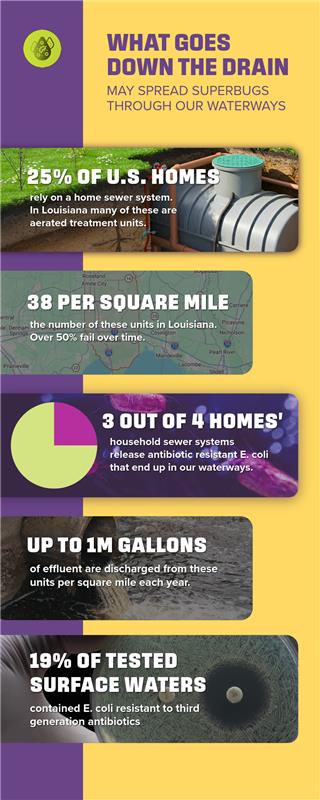
Imagine this scenario: your doctor sends you home with antibiotics for an infection, but you start feeling better and chuck the rest of your antibiotics – maybe you even flush them down the toilet.
What you don’t realize is that some bacteria in your body survive these drugs with adaptations – genetic changes – that make them resistant to the antibiotics you originally started taking.
This is especially likely when people don’t take antibiotics as prescribed. Some of these bacteria go down the drain as you use the bathroom or shower.
The problem is that these bacteria can enter surface waters and rivers and exchange genetic material with other bacteria there, leading to a spread of antibiotic drug resistance in other pathogenic microbes.
With wastewater monitoring, researchers can detect, community-wide, the prevalence of antibiotics and antibiotic resistance genes in water, capturing trends that might help them predict outbreaks of multi-drug resistant bacteria and pinpoint where decontamination efforts are needed.
Did you know?
17.5% of Louisiana's surface area is covered by water. Water is one of our most valuable assets and an incredible source of information about ecosystems and public health — but it can also pose a threat if not protected.
Tracking Addiction Through Wastewater

Kevin Murnane with Mary-Elizabeth Nordberg, a research associate in the Murnane Lab
One state leader in the use of innovative public health technology might be Kevin Murnane, PhD. He is an Associate Professor of Pharmacology, Toxicology & Neuroscience, as well as of Psychiatry and Behavioral Medicine, at LSU Health Shreveport (LSUHS).
Murnane and his team collect untreated wastewater samples monthly from eight locations across Caddo Parish, Louisiana. They upload the water test results to a dashboard where the team and other stakeholders can monitor levels of various analytes over time.
What is Murnane’s team looking for? The team is looking for signs of illicit and prescription drugs, and trends in their usage. They track everything from caffeine to opioids to methamphetamine.
“Our current surveillance panel consists of 21 different drug analytes. We can monitor drug level patterns over time, across different areas of the Parish,” said Mary-Elizabeth Nordberg, MPH, a research associate in the Murnane Lab who participates in handling wastewater collection.
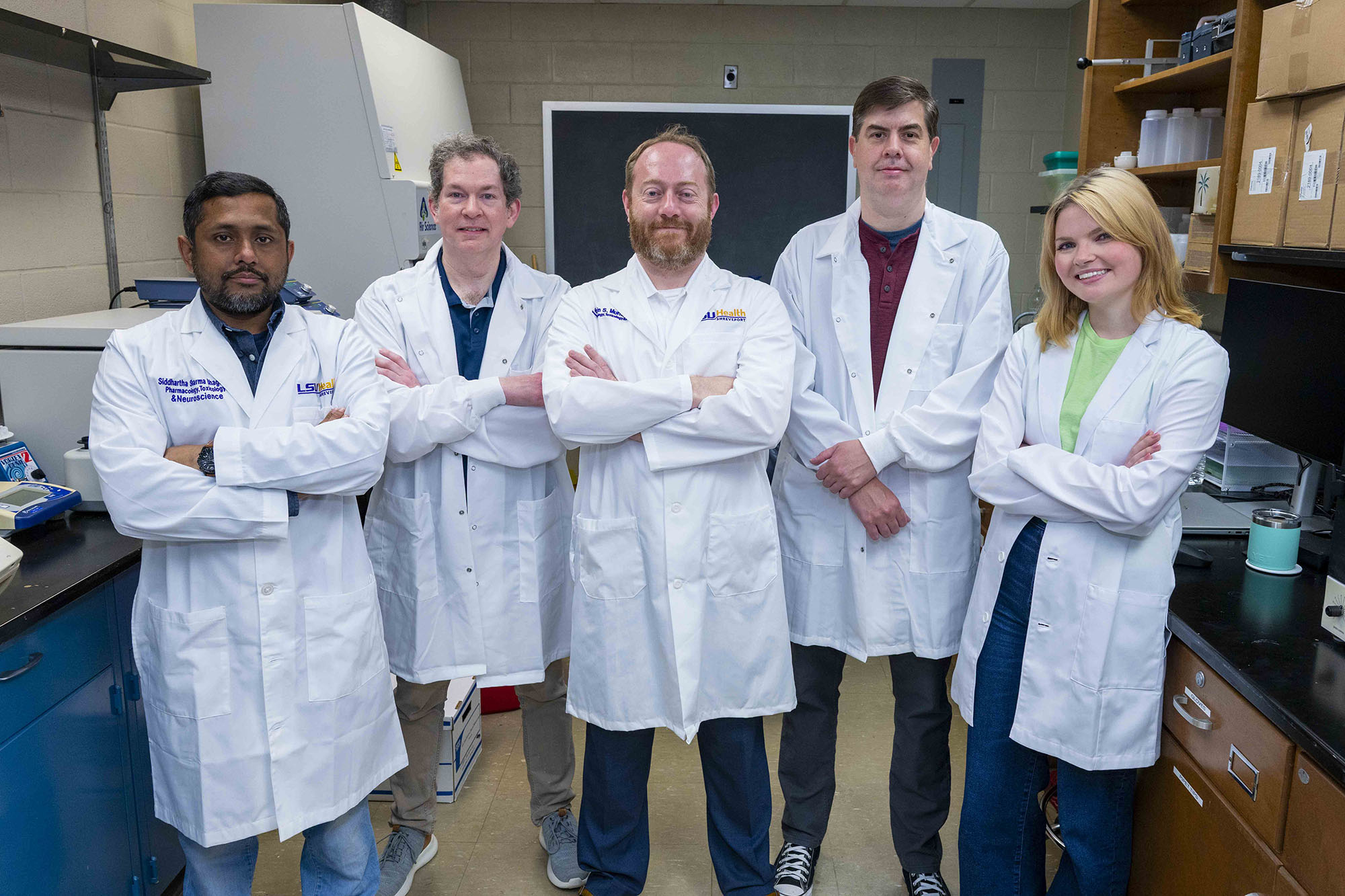
Kevin Murnane with some of the wastewater research team members.
The Team
This project involves a full team approach, with wastewater collection handlers Robbie Dayton, William Baldwin, Mary-Elizabeth Nordberg, and Siddhartha Bhagabati, data visualizers Kenny Densmore, Todd Nesson, and Jarrod Sawyer, and analysis from Hyung Nam PhD’s lab. Under the direction of Murnane, John Vanchiere MD, PhD, Nicholas Goeders, PhD, and Drew Mouton, their work combines elements of basic science research and public health.
Wastewater monitoring can provide a near-real-time, population-level picture of drug use trends. There are certainly other, more granular methods of assessing drug use: surveying potential users, collecting data about drug-related hospitalizations, and gathering data from law enforcement.
But these methods can lead to skewed data. People may be afraid to report drug use, and the potential for missing or incomplete data is high. Many people using drugs of interest may never interact with the healthcare system or law enforcement, creating data blind spots.
Wastewater, on the other hand, is objective, specific, and fair between different people and different communities. Wastewater monitoring data can also equally represent all regions where water is collected.
“Wastewater surveillance offers an objective and data-driven approach to evaluate drug use in all populations that drive efficient and customized support and resources for those communities in our state,” Murnane said.
The potential is immense. Murnane’s team can detect spikes in drug prevalence before hospital or first responder teams and alert the right people to respond quickly with prevention, treatment, and harm-reduction strategies (such as Narcan availability) to mitigate drug overdoses.
They can alert and prepare emergency room crews for spikes in fentanyl, methamphetamine, or designer drugs. They can alert physicians about new designed drugs found in wastewater that may not show up on conventional drug screens. They can overlay their wastewater data with maps of healthcare access, rural living, and other social factors to theoretically pinpoint communities where interventions are most needed, provided wastewater is collected from enough community sites.
“This data also allows us and others to assess whether new programs or initiatives are decreasing substance use and its associated harms in an objective manner, so that resources are used judiciously to have a real impact in our communities,” Murnane said.
Public Health: It’s in the Water
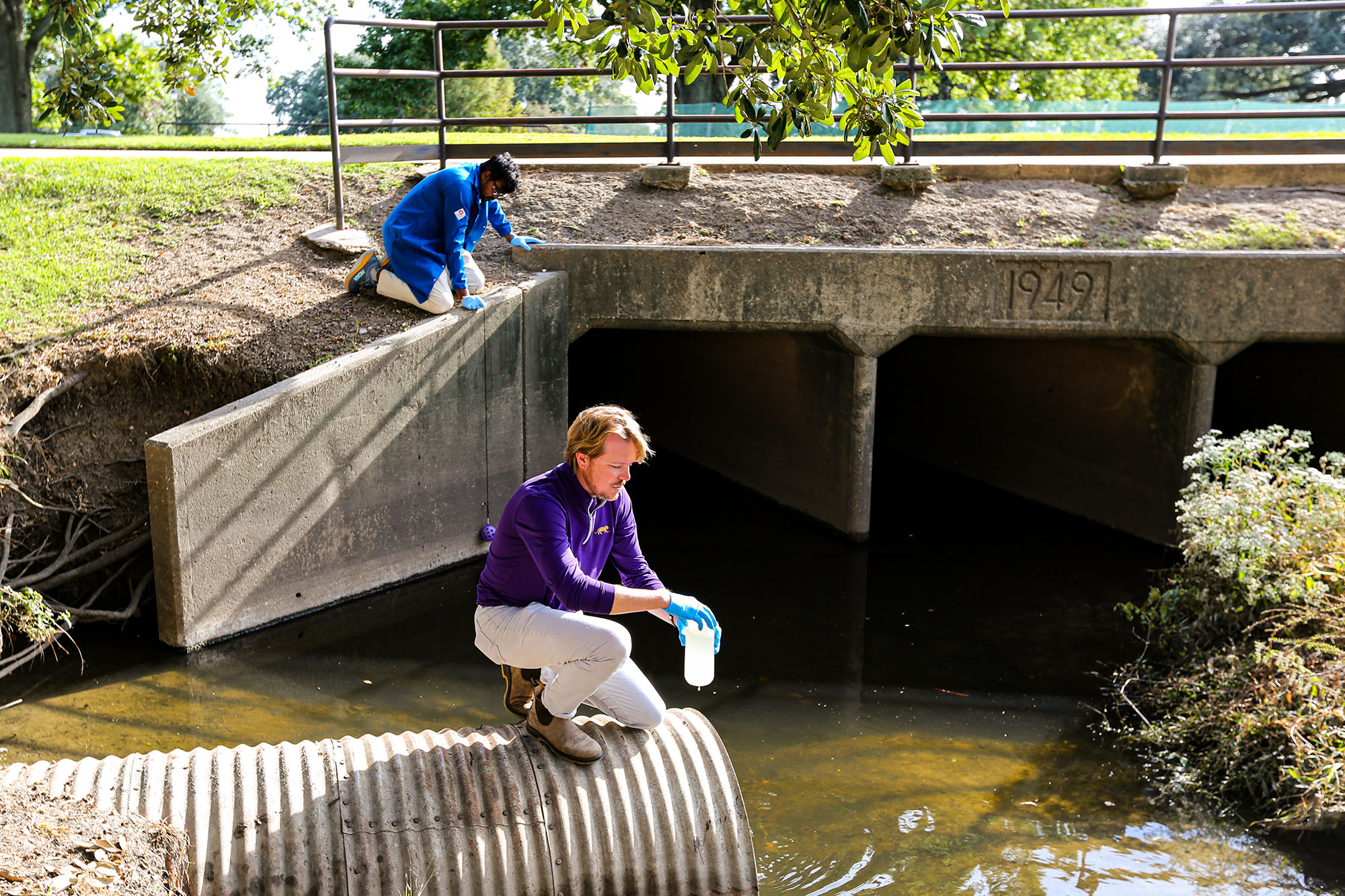
Aaron Bivins collects water samples with a team member.
Wastewater research is increasingly integral to early warning systems for emergent drug and pathogen threats, helping communities anticipate and prepare for challenges.
In fact, LSU Health Shreveport’s wastewater surveillance project began in 2021 to monitor COVID-19 in Shreveport by analyzing virus fragments in wastewater. Combined with emerging technologies like machine learning and AI, wastewater data can even help experts predict future disease and drug outbreaks based on current trends.
It is tempting, and troubling, to consider how this technology could have been useful in raising alarms earlier in the opioid crisis.
“By combining traditional indicators with wastewater measurements, we are able to gain a more comprehensive understanding of the trends in drug use we see today,” Nordberg said. “We are also able to show that every community faces the addiction crisis.”
For Aaron Bivins, an assistant professor of Civil and Environmental Engineering at LSU, wastewater monitoring is critical to tracking an emerging threat: fecal bacteria in Louisiana surface waters coming from dysfunctional household water treatment units.
In several preprint research studies currently awaiting publication, Bivins and colleagues report the results of sampling four different sites on two rivers in Louisiana’s Tangipahoa Parish over the course of 18 months.
“We have hundreds of samples from these rivers,” Bivins said. “What we see very consistently is a DNA marker from human sewage. That tells us there's a lot of sewage effluent coming from somewhere.”
But where is this sewage effluent coming from? Bivins lab started the work of tracing the sewage markers upriver, on a hunch testing roadside ditches and water coming out of home sewer systems.
“There are no centralized municipal sewer systems in these areas,” Bivins said. “They're peri- or ex-urban. Instead, people rely on home sewer systems. So each home has its little personalized wastewater treatment system. And historic data from inspections of these systems suggest that many of them are malfunctioning.”
Bivins sees this as a growing problem on a national scale. Up to 25% of households in the U.S. rely on a home sewer system.
Did you know?
Individual home sewer systems in rural Louisiana emit almost four times more nitrogen and phosphorus as the three largest wastewater treatment plants in Baton Rouge and New Orleans combined.
In Louisiana, most of these systems rely on aeration to fuel helpful bacteria that eat contaminants – somewhat similar to how composting works. If these systems are not properly maintained – or as is often the case, their aerators are switched off – they discharge undertreated wastewater.
This water can contain microorganisms that infect the gastrointestinal tract and cause disease. It also contains very high levels of nitrogen and phosphorus that can lead to toxic algal blooms and hypoxia in the Gulf of Mexico if not removed.
“Based on the things that we've measured, it doesn't look like water coming from these household water treatment units has been treated very well,” Bivins said. “This means there are potentially pathogens flowing directly into roadside ditches and eventually into waterways. Imagine you get a flood event, and now you've got potential human contact.”
Big Opportunities, Big Challenges
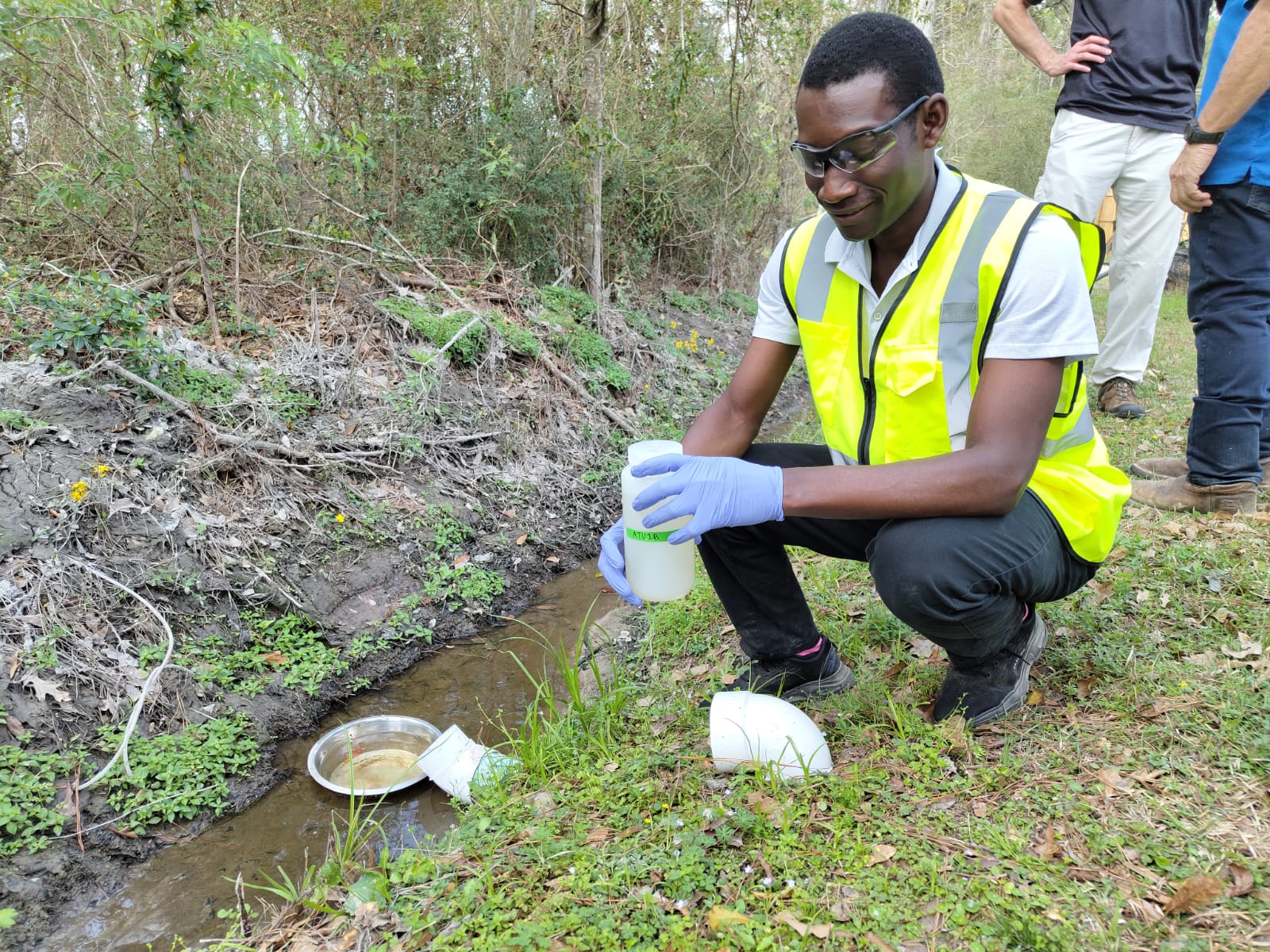
Ebenezer Etsiwah collects water samples.
Identifying and narrowing in on a big problem is the first step to addressing it. For Murmane’s lab, that might mean quantifying drug use by location to deliver interventions where they are most needed.
For Bivins, that might mean treating water after it leaves household sewer systems and before it reaches surface waters and local rivers, especially in rural areas with high densities of these individual household water treatment units.
Sam Snow, an associate professor in the Department of Civil and Environmental Engineering within the LSU College of Engineering is leveraging Bivins’ research to target UV treatment as a disinfectant for water flowing out of dysfunctional household water treatment units.
Snow built a prototype UV-light treatment device that can fit onto an existing home's sewer system discharge pipe, and Bivins’ lab collected data showing that this treatment can reduce a person’s risk of getting sick from the effluent by up to 94%.
But despite the power of wastewater surveillance data in identifying problems and efficient solutions, challenges remain. One of the largest is that of setting data standards and baselines.
“The levels of drugs or other compounds of interest we see in wastewater can change depending on variables such as rain or population changes during weekends or holidays,” Nordberg said. Pathogens, biomarkers, or other chemicals of interest in wastewater can also degrade over time, meaning they might not be detected in time to implement a solution.
This complicates the job of making sense of wastewater data. Is an observed surge in a particular drug analyte really representative of increased use? Or did a big sporting event temporarily raise drug levels in wastewater? Or was there a drought?
New Drugs? No Problem
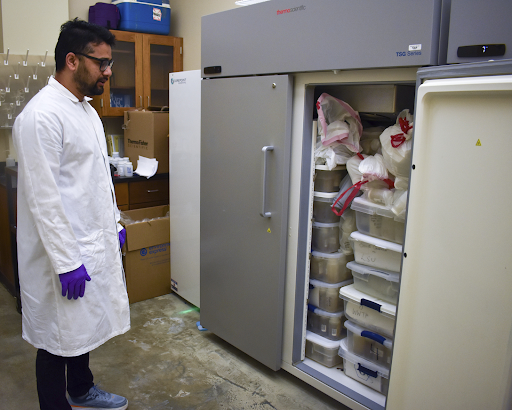
Bikram Subedi’s freezer is full of wastewater samples his team uses for public health data analysis.
Frozen wastewater covers nearly every square inch of a massive freezer in Bikram Subedi’s lab on LSU’s main campus. Subedi is an assistant professor of environmental sciences at the LSU College of the Coast & Environment.
These blocks of wastewater ice hold clues that Subedi’s lab uses to answer questions about illegal drug use and the persistence of harmful chemicals in drinking water.
Subedi recently made waves by publishing a study from wastewater sampling in New Orleans during the 2025 Super Bowl and Mardi Gras celebrations.
He and his team, including undergraduate and graduate students, developed tests for nine different nitazenes – new synthetic opioids more potent than fentanyl – in wastewater. They detected seven of the nine nitazene types in their samples, with increases following the Super Bowl and Mardi Gras.
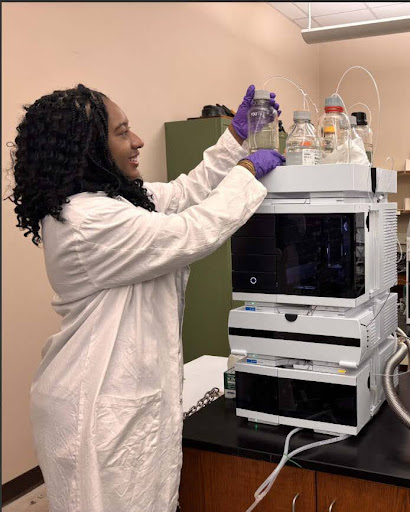
Alexia Cole uses an LC-MS/MS instrument to detect new types of drugs in water samples.
“This is the first time we’ve comprehensively analyzed all those nitazenes in wastewater and are able to detect those compounds,” Subedi told an LSU Reveille news reporter.
Subedi’s lab has the instrumentation and validation methods needed to rapidly detect and quantify more than 50 existing and novel drugs present in water samples. They use ultraperformance liquid chromatography-tandem mass spectrometry to identify compounds in water samples by their unique mass-to-charge ratios.
“We can determine how much cocaine was consumed yesterday in the entirety of Baton Rouge,” Subedi said.
Who knows what else Subedi might find in the blocks of wastewater, collected via auto-samplers from the local wastewater treatment facility, waiting to be analyzed in his lab’s giant freezer.
The lab is also using wastewater to monitor levels of toxic PFAS, or forever chemicals, in our state’s water sources and seafood. While activated carbon and specialized filters can remove PFAS from water, traditional water treatment methods can’t.
“Monitoring wastewater allows us to detect emerging threats like opioids and newer drugs before they lead to widespread harm,” said Alexia Cole, a student and LSU Gulf Scholar working in Subedi’s lab.
“This proactive approach helps public health officials respond faster, allocate resources better, and potentially save lives. It's an amazing tool to have to fight the drug crisis here in Louisiana.”
A Low-Cost Option
While the wastewater treatment facility auto-samplers that Subedi’s lab leverages to pull and monitor water samples as often as every 15 minutes are extremely convenient, they are also expensive.
A gold-standard wastewater sampler can cost over 10,000 dollars and collects data only at discrete time points.
Bivins has a different approach to wastewater monitoring to improve public health: low-tech passive water sampling. Passive wastewater sampling, which relies on a material such as activated carbon to adsorb contaminants from water, has been in use for decades. It was a leading method used by experts to track the polio epidemic in the 1940s and 50s.
Bivins’ lab has revived passive wastewater sampling with a simple, floating, 3D-printed ball with an enclosed activated carbon packet. This $4 passive water sampler can be anchored by a string and tossed into a sewage line or any other body of water for monitoring.
Microbes in the water adhere to the granular activated carbon. Researchers can later pull the sampler out, wash off the microbes, and test the resulting solution.
Bivins and colleagues recently found that they could detect genetic material from SARS-CoV-2 and Respiratory Syncytial Virus (RSV), as well as from harmful bacteria, with this simple passive water sampler.
Samples analyzed, Bivins’ lab can use computational techniques to predict disease risks. The Louisiana Universities Marine Consortium will soon be using Bivins’ passive water sampler to monitor for flesh-eating bacteria in Louisiana waters.
Researchers can leverage this water-sampling data to develop targeted engineering solutions to address disease risks, such as using UV-LEDs to disinfect sources of contamination in waterways.
The work of Bivins’ lab shows that wastewater monitoring doesn’t have to be expensive. Passive sample collectors can bring the benefits of wastewater surveillance to low-resource settings.
Expanding Wastewater Surveillance State-Wide
“LSU is one of the few institutions in all of the US South conducting wastewater studies,” said Will Baldwin, a research associate in the Murnane Lab who participates in handling wastewater collection. “This shared expertise has accelerated innovation in this field.”
Dr. Murnane and the team in his lab hope to see wastewater monitoring expand throughout Louisiana. His team at LSUHS is collaborating with other researchers on LSU's main campus and is working to refine their testing methods so that their samples can reliably support multiple types of public health monitoring. They also hope to increasingly see wastewater data integrated with other data streams, such as hospital data, crime lab data, and Louisiana Department of Health data.
“By collecting longitudinal wastewater data and integrating it with other data for trend interpretation, we can demonstrate that wastewater research is a versatile tool that allows us to deploy finite resources to effective programs that position Louisiana to be a leader regionally and nationally, and benefit our state for generations,” Murnane said.
Story Sources
- Research team awarded grant to study use of wastewater as fertilizer
- LSU researcher, students develop new method for tracking synthetic opioids through wastewater
- Nitazenes Discharged during Super Bowl and Mardi Gras Celebrations in New Orleans, USA
- Using Chemistry to Make Louisiana Healthier
- The Opioid Crisis Is Now Being Tracked with Wastewater
- A Brief History of Wastewater Testing and Pathogen Detection
- A narrative review of wastewater surveillance: pathogens of concern, applications, detection methods, and challenges